

How to Reduce Impurities in Solid-Phase Peptide Synthesis (SPPS): A Complete Guide
How to Reduce Impurities in Solid-Phase Peptide Synthesis (SPPS): A Complete Guide
Solid-phase peptide synthesis (SPPS), introduced by Bruce Merrifield in 1963, remains the backbone of modern peptide manufacturing. Over six decades later, it is still the method of choice for producing research-grade and therapeutic peptides at scale. Yet despite enormous technological progress, impurity formation continues to be one of the most persistent obstacles standing between a synthesis run and a commercially viable, regulatory-compliant product.
For pharmaceutical peptides such as Semaglutide, Tirzepatide, Octreotide and Leuprolide, impurity control isn't a secondary concern, it's the difference between a batch that clears specification and one that doesn't. Every impurity that forms during synthesis has to be removed downstream and removal is rarely simple. Many impurities are structurally so close to the target peptide that they co-elute during purification, driving up costs, lowering yields and in some cases compromising the final product's safety profile.
Why Impurities Accumulate and Why Length Makes It Worse
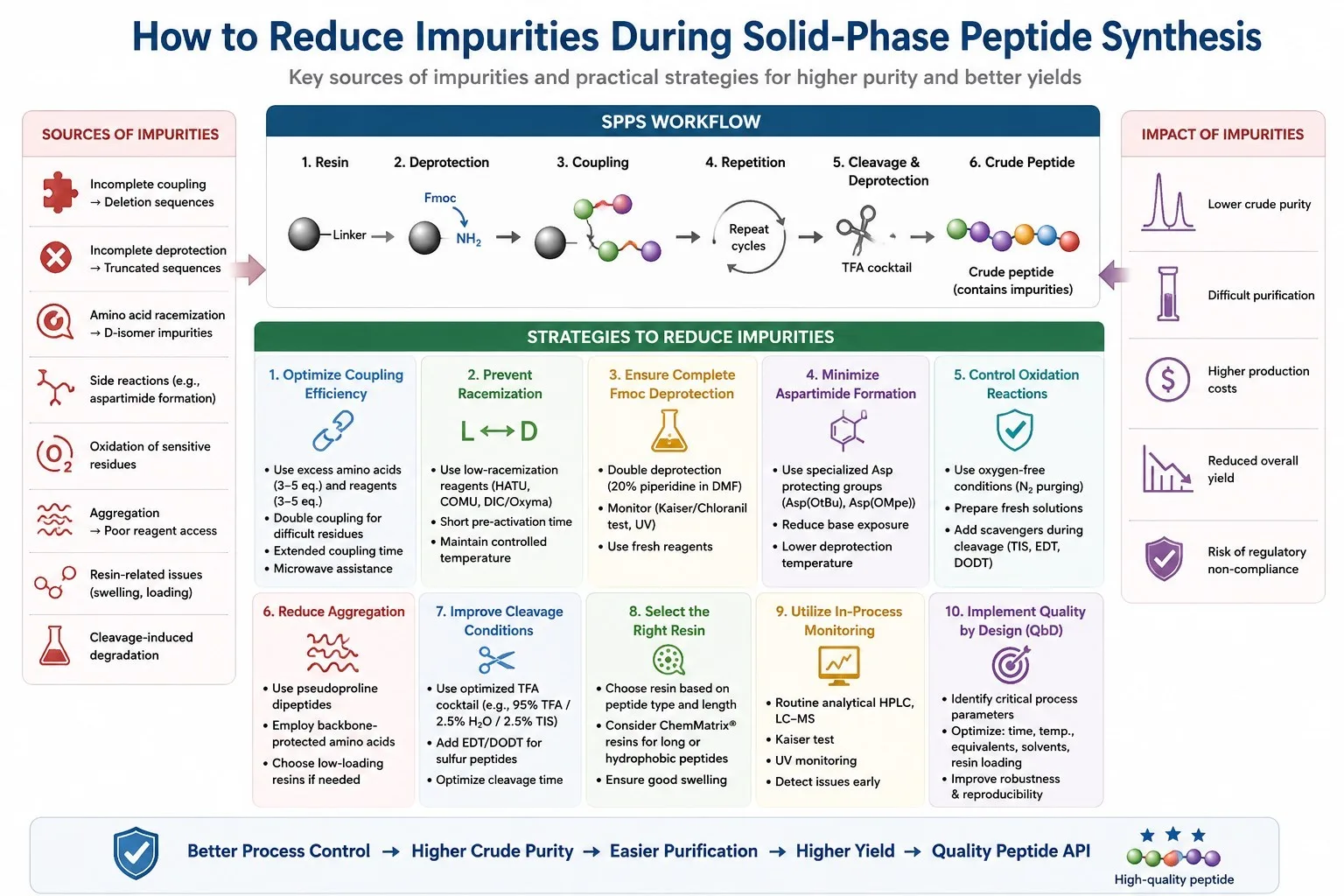
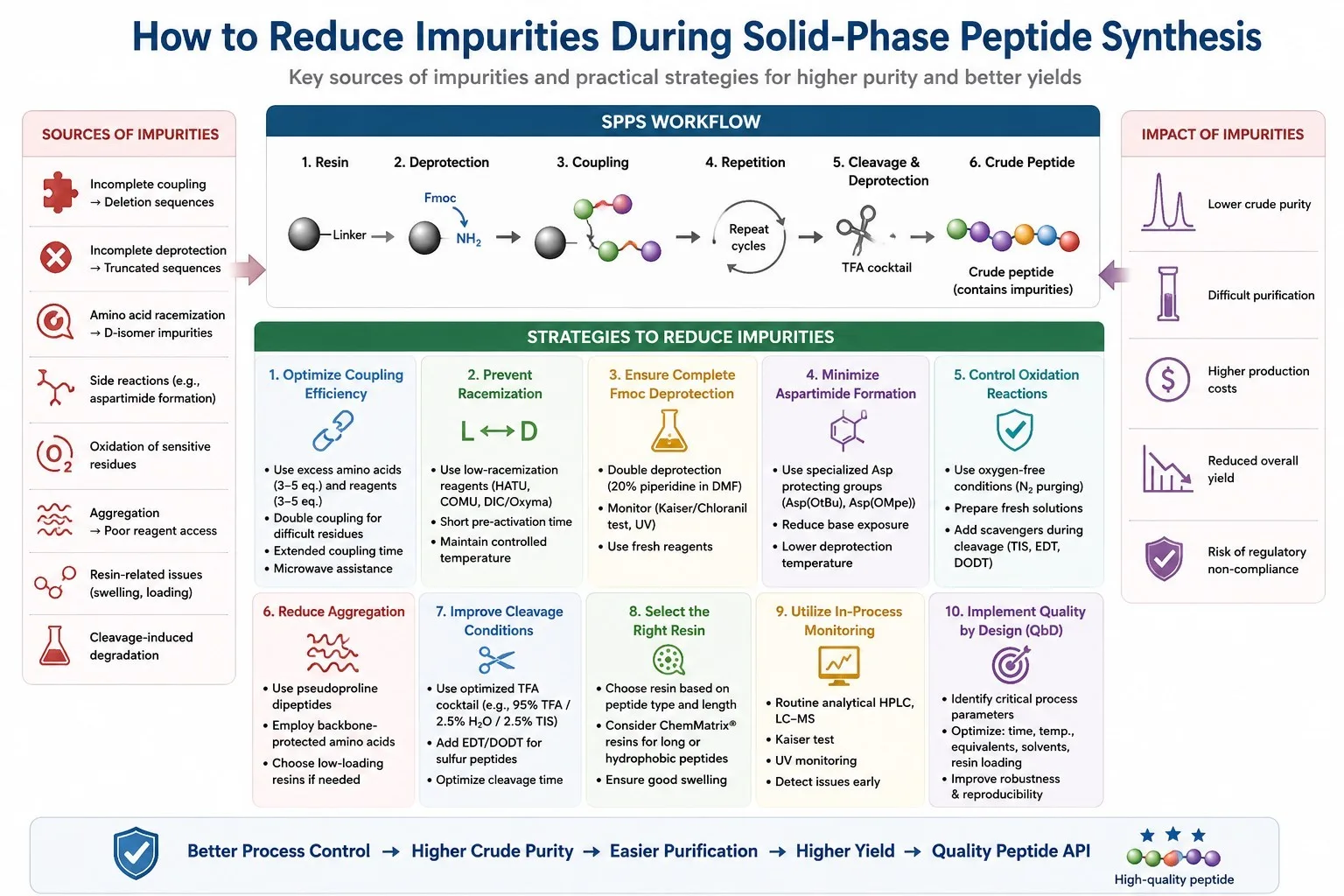
Impurities in SPPS arise from a fairly predictable set of mechanisms: incomplete coupling, incomplete deprotection, racemization, side-chain modification, oxidation, aggregation, resin-related issues and degradation during cleavage. Individually, each of these can usually be managed. The real difficulty is that their effects compound as peptide length increases.
Consider a coupling efficiency of 99%, which on paper looks like a near-perfect reaction. Extend that efficiency across a 30-residue peptide, however and the theoretical maximum purity drops to roughly 74%. This is the quiet arithmetic that underlies most SPPS impurity problems: small, seemingly negligible inefficiencies at each step accumulate into substantial purity losses by the time synthesis is complete. It's why even modest improvements in coupling efficiency or deprotection completeness can have an outsized effect on final crude purity.
Optimizing Coupling Efficiency
Incomplete coupling is the single largest source of deletion sequences, peptides missing one or more residues that are notoriously difficult to separate from the target product. Steric hindrance, poor resin swelling and aggregation of the growing chain are the usual culprits, particularly with bulky or hydrophobic residues.
The standard countermeasure is to push the reaction toward completion by using excess reagent, typically 3 to 5 equivalents each of amino acid and coupling reagent. For residues that are known to be difficult, valine, isoleucine, threonine and arginine among them, double coupling is often necessary to meaningfully reduce deletion impurities. Extending reaction time can help with sterically hindered sequences and microwave-assisted synthesis has increasingly been adopted because it accelerates coupling kinetics while simultaneously improving crude purity and overall yield.
Preventing Racemization
Racemization, the conversion of L-amino acids into their D-isomers, creates impurities that are chemically similar enough to the target peptide to co-elute during analysis and purification. Cysteine, histidine, serine and aspartic acid are particularly prone to this side reaction.
The choice of coupling reagent matters more here than almost anywhere else in the process. Modern activation systems such as HATU, COMU and DIC/Oxyma Pure produce substantially less racemization than older reagent classes. Limiting pre-activation time to just a few minutes and keeping reaction temperatures controlled are equally important, since excessive heat accelerates epimerization regardless of which reagent is used.
Ensuring Complete Fmoc Deprotection
Incomplete removal of the Fmoc protecting group leads directly to truncated sequences, one of the more common forms of deletion impurity. The standard solution is a double deprotection cycle using 20% piperidine in DMF, typically run as a 5-minute treatment followed by a 10-minute treatment. Verifying completeness matters just as much as the protocol itself, the Kaiser test, the chloranil test and UV monitoring are all used to confirm that deprotection has actually gone to completion. It's also worth noting that degraded piperidine solutions are a frequent, underappreciated cause of incomplete deprotection, fresh reagent preparation is a simple fix that's easy to overlook.
Minimizing Aspartimide Formation
Aspartimide formation is a side reaction specific to aspartic acid residues and it shows up reliably in particular sequence contexts: Asp-Gly, Asp-Ser and Asp-Asn. Because it's sequence-dependent, it can often be anticipated and designed around. Specialized protecting groups such as Asp(OtBu) and Asp(OMpe) reduce the rate of this side reaction substantially and limiting both base exposure (shorter piperidine treatments) and deprotection temperature further suppresses it.
Controlling Oxidation
Methionine, cysteine, tryptophan and tyrosine are all susceptible to oxidative degradation during synthesis and cleavage. Nitrogen purging to maintain oxygen-free conditions, combined with the use of freshly prepared coupling reagents, addresses much of the risk during synthesis itself. The cleavage step requires its own protection: scavengers such as TIS, EDT and DODT shield oxidation-sensitive residues from the harsh conditions of TFA cleavage.
Reducing Aggregation
Aggregation of the growing peptide chain restricts reagent access, lowers coupling efficiency and increases the frequency of deletion sequences, making it one of the more frustrating problems to diagnose mid-synthesis. Pseudoproline dipeptides are widely used to disrupt the secondary structure formation that drives aggregation and backbone-protected amino acids serve a similar purpose in aggregation-prone stretches of sequence. Resin choice also plays a role here: low-loading resins frequently improve outcomes for difficult sequences by reducing local chain-chain interactions on the solid support.
Improving Cleavage Conditions
The cleavage step, where the finished peptide is released from the resin, introduces its own set of risks: oxidation, alkylation, deamidation and incomplete side-chain deprotection. A standard cleavage cocktail of 95% TFA, 2.5% water and 2.5% TIS covers most sequences, with EDT or DODT added for peptides containing sulfur-containing residues. Cleavage time is a balancing act: long enough to ensure complete release and deprotection, but not so long that secondary degradation products start to form.
Choosing the Right Resin
Resin selection shapes nearly every downstream outcome. Wang resin remains the standard choice for peptide acids, Rink amide resin for peptide amides. For long, hydrophobic or otherwise difficult sequences, ChemMatrix resin has become a preferred option, its improved swelling characteristics in a range of solvents often translate directly into higher crude purity.
In-Process Monitoring and Quality by Design
None of the above matters if problems aren't caught early. Analytical HPLC, LC-MS, the Kaiser test and UV monitoring give real-time visibility into how a synthesis is progressing, allowing issues to be addressed before they compound into significant impurity accumulation.
At a process level, a Quality by Design (QbD) approach formalizes this kind of vigilance. By systematically mapping critical process parameters, coupling time, temperature, amino acid equivalents, solvent quality and resin loading, manufacturers can build reproducibility and scalability into the process itself, rather than relying on after-the-fact troubleshooting.
Concluding Remarks
Impurity control in SPPS comes down to managing a fairly well-understood set of failure modes: incomplete reactions, side reactions, aggregation and oxidative or hydrolytic degradation. None of these are exotic problems, but each requires deliberate attention, in reagent selection, in protocol design and in analytical monitoring, to keep under control. As peptide therapeutics continue to expand across diabetes, obesity, oncology and infectious disease treatment, the manufacturers who treat impurity control as a design parameter rather than an afterthought will be the ones best positioned to meet increasingly stringent quality and regulatory expectations.
Stay Updated
Follow Provis Biolabs on LinkedIn for the latest biotechnology insights, product announcements and company news.